
Showing posts with label Armenia. Show all posts
Showing posts with label Armenia. Show all posts
Tuesday, November 25, 2008
Armenia Wins Gold; Israel Silver
Armenia placed first in the Chess Olympiad held in Dresden, Germany this past week, and Israel scooped up a silver medal, finishing one point behind the winner. While Armenia was favored to win the tournament, the Israeli team was not expected to perform this well.


Thursday, September 11, 2008
Movement in Armenian-Jewish Relations
The fallout from the August 2007 Watertown-ADL controversy (see #1, #2) is slowly changing Armenian-Jewish relations - perhaps for the better. As a result of the uproar by Watertown's Armenian community over the Anti-Defamation League's stance on recognition, the heads of both the ADL and the American Jewish Committee (AJC), Abe Foxman and David Harris respectively, issued statements recognizing the 1915 killings of Armenians in the Ottoman empire as genocide.
Now, the AJC reports in an October 9, 2008 press release, "The Armenian Church has presented the American Jewish Committee (AJC) with a gold Kiddish cup, a Jewish ceremonial goblet, in appreciation of the long, positive history of close ties between the Armenian and Jewish peoples."
Although the press release quotes the Archbishop of the Diocese of the Armenian Church of America (Eastern), Turkish-born Vicken Aykazian, speaking at an AJC Board of Governors Meeting in New York, the cup was actually first presented to an AJC delegation in the Republic of Armenia back in May 2008. That AJC delegation included Barry Jacobs, the organization's D.C.-based Director of Strategic Studies, and Ambassador Peter Rosenblatt, who received the cup from His Holiness Karekin II, Supreme Patriarch and Catholicos of All Armenians. Jacobs and Rosenblatt also met with the prime minister of Armenia, Tigran Sargsyan
The kiddush cup theatrics and the AJC press release suggest a warming of relations between American Jewish organizations and American Armenians as well as the current government of Armenia. But the visit was not without its detractors in the American Armenian community, some of whom regard the AJC and Barry Jacobs in particular as chief antagonists in the struggle for U.S. recognition of the Armenian Genocide. In a somewhat allusive and occasionally confusing article denouncing the entire visit as a "machination," Jirair Haratunian claims that
Jacobs circulates articles from various sources supporting not only Israeli positions but pro Turkish and pro Azerbaijani policies as well. Jacobs’s bias against Armenia is palpable. A New York Times photograph taken at the session of the House of Representatives’ Foreign Affairs Committee showed Jacobs seated among a group of Turkish protesters wearing badges saying “NO” to the pending Genocide resolution.
Jacobs was a long-time Department of State employee before beginning work for the AJC. He is a classic realpolitiker with little patience for history when it gets in the way of the interests of the United States and the Jewish community as he (and many other foreign policy analysts) perceive them. But two factors may be compelling him and others to sing a different tune as of late.
For one, American Jews like most other Americans, once informed of the issues, tend to support recognition of the Armenian Genocide. More importantly, however, there are real developments afoot in the South Caucasus and in Turkey that may call for a revision of entrenched positions.
First, the current regime in Yerevan may be headed for rapprochement with Turkey. Second, the Georgian crisis along with a host of other factors that have been stewing since the American invasion of Iraq are contributing to geopolitical uncertainty in the Caucasus.
All the players in the South Caucasus, including the Russians, are trying to balance their long-term interests with their current alliances. With Georgia and the Baku-Tblisi-Ceyhan pipeline facing an uncertain future, Armenia, currently Russia's most stable ally in the region, may reap benefits (though, to be sure, it will also endure significant economic costs). The U.S. may lose the most if it does not act fast. Certainly, Armenia has improved its strategic worth since the Georgian war.
In a catastrophically-translated press release about the AJC visit, the Republic of Armenia expressed some hope that the Jewish organization may help to improve Armenian ties with the U.S. and Armenia's relations with its neighbors:
During the meeting, the Prime Minister of Armenia and the head of the Jewish Committee of America touched upon the possibilities for improvement of the Armenian-Turkish and Armenian-Azerbaijani relations, the furtherance and expansion of cooperation with the United States [...] as well as the outlook for [...] strengthening the Armenian-Israeli political ties based on the historical and many other affinities between the Armenian and Jewish peoples. The parties said to be convinced that this might be instrumental in the betterment of Armenia's relations with the countries of our region. Peter Rosenblatt emphasized the need for raising awareness about Armenia in Israel which is susceptible to be ensured through active implementation of [...] cultural, educational and other programs.Prime Minister Tigran Sargsyan reiterated our country's position with regard to the settlement of its relations with Turkey by stressing Armenia's readiness to establish relations without pre-conditions.
Wednesday, August 08, 2007
Second Armenian Church to be Turned into a Museum in Turkey, Or How to Keep Falsifying History with European Funding and Approval
According to PanArmenianNet, an Armenian church in the Edremir district of Van is being reconstructed with European funding. As for the Holy Cross Church on Akhtamar Island a few months ago, this church should be turned into a museum. No doubt, like for the Holy Cross, there will be no mention whatsoever of how this church came to be deserted, when and why. Nor why the church was left abandoned for so many decades. As a perfectly politically healthy place in Turkey, the museum will show the Turkish account of Armenian's presence in Van.
Friday, April 13, 2007
Serge Sarksian remplace Markarian dans ses fonctions de Premier Ministre
La nouvelle date d'il y a quelques jours déjà, mais je dois avouer que le manque de surprise dans le développement cette affaire m'a fait passer l'envie d'écrire à ce sujet. Alors qu'au lendemain du décès de Markarian, une tension semblait se dessiner au sein de l'administration, qui aurait pu placer Hovig Abrahamian dans la course pour le poste, c'est en définitive sans heurt aucun que Kotcharian a reporté son choix sur l'éternel Ministre de la Défense Sarksian. Ce geste rend nulles les suppositions quant à une rivalité entre le futur Président sortant et l'actuel Premier Ministre qui sera à n'en pas douter, reconduit dans ses fonctions à l'issue du scrutin législatif du mois prochain. Le verrouillage des postes en prévision de l'élection présidentielle de l'année prochaine se confirme, et selon toute vraissemblance, Sarksian se donne une garantie de plus due à un -heureux?- hasard de placer toutes les ressources administratives de son côté. Quant à Kotcharian, qui lui aura apporté un soutien indéfectible en dépit des légères tensions d'il y a quelques mois, il s'assure sans doute un "parachute doré" pour sa sortie de la Présidence, et assurer la continuité du travail gouvernemental pour les 5 années suivantes. Pendant ce temps, l'opposition, prévoyant comme d'habitude sa victoire en cas d'élections transparentes, a pour la enième fois appelé les gens de la rue en perspective d'un renversement révolutionnaire après les élections, avec la même crédibilité que depuis 2003... L'immobilisme politique en Arménie est toujours aussi fort.
Monday, March 26, 2007
Décès inattendu du Premier Ministre arménien
 Andranik Markarian, 1951-2007 (Photo: Iran-Daily)
J'ai appris hier matin -de bouche à oreille- que le Premier Ministre arménien Andranik Markarian était décédé d'une crise cardiaque. Après avoir en vain fait le tour des principales radios d'information, des dépêches AFP, du site du Monde, etc. j'ai décidé d'attendre confirmation avant de me faire l'écho de la nouvelle -sur notre blog, même si cette affaire ne concerne pas particulièrement la communauté juive. Heureusement ce matin les media arméniens -non, pas internationaux, quel journaliste sensé perdrait son temps sur une nouvelle aussi peu grand public?- donnaient davantage de précisions sur ce décès.
Apparemment l'ex-Premier avait de lourds antécédents en matière cardiaque: il se faisait régulièrement suivre en Russie et en France. Une paralysie du coeur l'a pris dans son appartement et les médecins ont inutilement tenté de le réanimer.
Des funérailles d'Etat sont prévus par le Président Kotcharian, qui a déclaré être profondément touché. Il a immédiatement prévenu son Ministre de la Défense, Serge Sarksian, qui en route pour une visite officielle en Chine a annulé son voyage. Une réunion d'urgence a eu lieu hier, et une autre est prévue pour aujourd'hui, dès le retour de Sarksian. Quant aux suites deux tendances semblent se dessiner. Kotcharian pencherait pour un candidat proche de lui au poste, en la personne de Hovik Abrahamian, actuel Ministre du Gouvernement local, une des figures montantes du régime depuis trois ans. Ce mouvement s'est accéléré en 2005, quand Kotcharian a inclus le département des Réfugiés et situations d'urgence dans le Ministère du Gouvernement local, le tout confié à Abrahamian. Ce choix pourrait cependant créer de nouvelles vagues entre Kotcharian et Sarksian, qui fera sans doute son possible pour pousser un homme à lui, quelqu'un de discret et d'acquis, et qui lui rendra la campagne présidentielle de l'an prochain que plus aisée. Affaire à suivre...
Je vois l'information pour la première fois sur un media international sur le site de la BBC.
Monday, March 19, 2007
Armenian Embassy in Ottawa, Canada
 The Armenian embassy in Ottawa, Canada (March 2007)
I thought I'd post a picture I took recently of the Armenian Embassy in our nation's capital. In my opinion, it's quite striking. Note the Ararat motif in one of the gables. The embassy is located close to the downtown area, near the Rideau Canal on which people frequently skate during the winter. I don't know the significance of the statue on the right - if any of our readers could enlighten us on that point, your help would be much appreciated.
Monday, January 29, 2007
The Manipulations of Alexandre Adler
 Alexandre Adler
Hrant Dink must be turning in his grave about all the articles that have invoked him to argue for causes quite foreign to his own. While we might applaud the fact that Dink's murder has forced many Turks to speak out publicly against the nationalist ideology that caused his death, some unsavory characters have perversely seized the occasion to attack diaspora Armenians and the Republic of Armenia. Alexandre Adler's recent column in Le Figaro to me represents the height of this kind of cynicism.
Adler's essay crafts "connections" between ideas and events that are hallucinatory at best. After eulogizing Dink for one paragraph, Adler proceeds to launch into a vicious tirade against Armenia only to end with a melodramatic paean to the founder of post-Soviet Azerbaijan and the father of the state's current ruler:
Héros de l'Union soviétique, fils de mollah, excellent connaisseur de la poésie persane et patriote turc à la Mustafa Kemal, Haidar Aliev synthétisait ces courants culturels apparemment incompatibles, en tout cas aujourd'hui, en un espoir utopique pour demain : la grande alliance des trois cultures russe, turque et persane dans un nouvel ensemble producteur de laïcité et de démocratie.Adler then has the audacity to declare that
[A USSR hero, son of a mullah, remarkable connoisseur of Persian poetry, and a patriotic Turk, Haidar Aliev combined those cultural currents which, at least today, seem incompatible, with a utopian hope for tomorrow: the great alliance of three cultures - Russian, Turkic, and Persian in a new fusion producing secularism and democracy.]
Si un jour nous parvenons à réaliser cette ambition, on se souviendra de Dink comme de l'un des héros stoïques de cette indispensable longue marcheAdler's enlistment of Dink in his ode to Haidar Aliev is distasteful enough, as is his characterization of Armenia as a "violent, aggressive, and inept" country. But even more insidious is Adler's effort to link Armenia to Russian and Arab terrorism, and, along the way, to establish some kind of moral equivalence between the genocide of 1915 and Armenians' alleged crimes in recent times:
[If one day we manage to achieve this ambition, we will remember Dink as one of the stoic heroes of this long, vital march.]
Certes, la Turquie devrait avancer avec retenue et dignité vers une prise en compte de plus en plus lucide de la tragédie de 1915, mais l'Arménie d'aujourd'hui a aussi son chemin à accomplir pour conjurer une bonne fois pour toutes son alliance faustienne avec les éléments les plus terroristes de l'ex-Union soviétique et du monde arabe, le moment Asala, si on cherche à lui donner un nom.
[Surely, Turkey must advance with self-restraint and dignity toward a more and more lucid accounting of the tragedy of 1915. But today's Armenia also has a ways to travel to conjure {i.e., "do away with"} once and for all its Faustian deal with the most terrorist elements of the former Soviet Union and the Arab world, the Asala moment, if one is looking for a name to give it.]
Few would deny that Armenia, like a host of other former Soviet republics, is experiencing some serious problems. The most serious challenge facing the country is the ongoing blockade against it by Turkey, and by Azerbaijan, with which it continues to be embroiled in a conflict over Nagorno-Karabakh. Other troubles include corruption and authoritarian tendencies among some of its leaders - tendencies that are abundant elsewhere in the region (indeed, Azerbaijan probably takes the prize). But to link Armenia to Islamist or ex-Soviet terrorism is an insidious lie.
Asala (the Armenian Secret Army for the Liberation of Armenia) was a terrorist group active in the late 1970s and until the early 1980s, which assassinated Turkish diplomats in the West. It was founded and based in Beirut during the Lebanese civil war. But it had no connection at all to Armenia, which in any case was a Soviet republic then. Nor was it ever embraced by the vast majority of Armenians in the diaspora.
Finally, as horrible as the actions of the now defunct group may seem today, anyone who seeks to compare them with the genocide of 1.5 million Armenians is nothing but a vicious demagogue.
On top of all this, after linking Armenia to the attempted assassination of John Paul II (a connection that seems as solid as the visions produced by the mushrooms he must have ingested), Adler also manages to drag the Jews into the whole mess, of course on his side. As if the innuendo about Armenian connections to Arab terror weren't enough, he praises Haidar Aliev as someone "qui aurait banni ... racisme et antisémitisme" [who would have exiled racism and antisemitism].
Both advocates for the recognition of the Armenian Genocide as well as their opponents have appealed specifically to Jews and their historical experience to aid their respective causes. One canard circulating among various denialist groups is the claim that Armenians were or are antisemitic, which is part of a transparent effort to impugn Armenian credibility and to provoke antipathy toward the cause of genocide recognition among Jews. Adler seems to be employing a similar strategy by linking Armenians to Arab terrorism, while presenting Aliev as a heroic vanquisher of antisemitism. I think I speak for many Jews when I say that I want no part in Adler's dangerous game.
Tuesday, December 19, 2006
Israeli-Armenian Relations
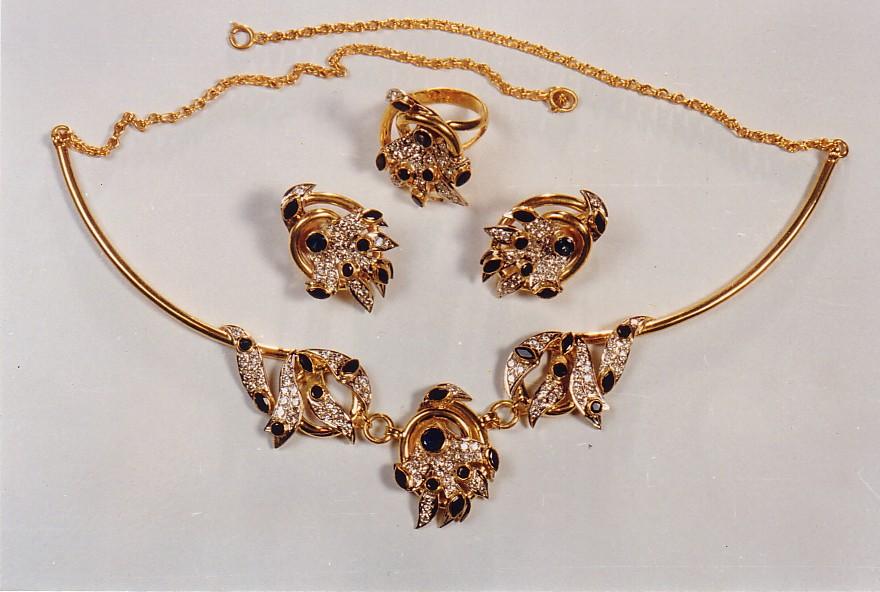
Most Armenians in the Diaspora know about Israel's relations with Turkey, but I bet far fewer know that Israel is one of Armenia's top-five trade partners. Almost all of this trade is in diamonds, as is most of the trade between Armenia and Belgium (where, it should be noted, Jews are the major players in the industry).
David, over at a The Armenian Economist (a great blog, by the way), provides the following data for 2005 in a post on "Georgia, Russia, and Armenia's Economy."
Total exports (USD millions): 950.4
- Germany 147.2
- Netherlands 130.1
- Belgium 124.6
- Russia 119.1
- Israel 112.2
- USA 62.1
- Other 255.0
- Russia 259.5
- Belgium 162.4
- USA 116.0
- Germany 114.0
- Israel 102.5
- Iran 102.0
- Other 911.5
- Germany (15.6% of exports)
- Netherlands 13.7%
- Belgium 12.8%
- Russia 12.2%
- Israel 11.5%
- US 11.2%
- Georgia 4.8%
- Russia 13.5%
- Belgium 8%
- Germany 7.9%
- Ukraine 7%
- Turkmenistan 6.3%
- US 6.2%
- Israel 5.8%
- Iran 5%
- Romania 4.2%
Saturday, October 07, 2006
A Medieval Jewish Cemetery in Armenia
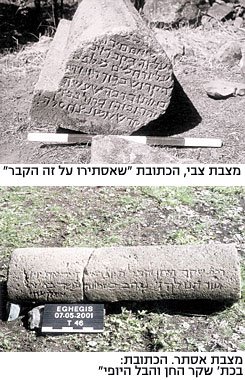 Two tombstones from the cemetery. The top one is from the grave of "Zvi the righteous, upright and lovely boy." On the bottom is the tombstone from the grave of Esther the daughter of Michael. Part of a verse from Proverbs (31:30) is visible in the photograph, "Grace is deceitful, and beauty is vain."
Ha'aretz has a long feature by archaeologist David Amit on the finds from the latest expedition to a medieval Jewish cemetery that was discovered in Armenia nearly a decade ago. Unfortunately, the article, entitled "Hebrew Gravestones in the Land of Ararat" is so far available only in Hebrew. The expedition was led by Professor Michael Stone, director of the Armenian Studies program at Hebrew University. The article itself details some of the findings from the various expeditions, and includes translations of a number of interesting tombstone inscriptions. The cemetery is located in Eghegis, in the Vayots Dzor Region, and it dates to the 13th century. The Jewish community that lived in the area appears to have come from Persia. For those who are interested, a full report by Stone and Amit appeared in the Journal of Jewish Studies, Vol. 57, Issue 1 (2006).
The cemetery first came to the attention of the scholars from Jerusalem when they were contacted by the local Armenian Bishop Abraham Makartchian in 1997. Bishop Makartchian runs a summer camp in Eghegis for orphans who lost their parents during the long war with Azerbaijan. The young and energetic "Bishop in jeans," as Amit calls him, also graciously hosted the archaeologists.
Thursday, September 14, 2006
Armenia Debates Sending Peacekeepers to Lebanon
Armenia is debating whether to send peacekeepers to Lebanon, after receiving an official invitation to join the UNIFIL mission there. Lebanon has a large Armenian community, and Lebanese Armenians are urging the country's participation in the peacekeeping mission. If the government decides to accept the invitation, it is likely that a small contingent of Armenian sappers would be involved in the clearing of mines and unexploded ordnance. According to Oskanian, there are still questions about the mandate and the location in which the troops would be serving, which need to be resolved before Armenia can commit.
On Wednesday, a Turkish reconnaissance team arrived in Lebanon. The Turkish parliament gave its overwhelming approval to a bill Turkey is expected to contribute up to 1,000 troops. However, the country has declared in advance that it will withdraw if its soldiers are asked to disarm Hizbullah. Turkish public opinion is largely opposed to the country's participation in the mission.
Shahan Kandakharyan, editor-in-chief of Azdak, the largest Armenian newspaper in Lebanon, has announced that Lebanese Armenians are opposed to Turkey's participation in the mission:
he said (see full text of an interview with him).
Meanwhile, Germany has announced that it will contribute 2,400 airforce and navy servicemen to the UN peacekeeping mission in Lebanon. German defence minister Franz Josef Jung announced that the country's sailors and airmen, who will be patrolling the entire Lebanese coast, aboard two frigates, four patrol boats, two supply ships, a tender, and two helicopters, "will have the right to use force against vessels that show resistance." Chancellor Angela Merkel called the decision to participate "historic." However, Germany has refused to send ground forces to Lebanon, citing concerns that the country's Nazi past prevents it from putting troops in a situation where they might have to challenge Israeli soldiers. Israelis have generally welcomed the German participation, with some isolated opposition. However, a month ago, when debates about a new peacekeeping force had just begun, the head of the Central Council of Jews in Germany vehemently objected to the deployment of German troops in Lebanon. Israeli Prime Minister Ehud Olmert previously expressed his strong support for a German role in the mission.
On Wednesday, a Turkish reconnaissance team arrived in Lebanon. The Turkish parliament gave its overwhelming approval to a bill Turkey is expected to contribute up to 1,000 troops. However, the country has declared in advance that it will withdraw if its soldiers are asked to disarm Hizbullah. Turkish public opinion is largely opposed to the country's participation in the mission.
Shahan Kandakharyan, editor-in-chief of Azdak, the largest Armenian newspaper in Lebanon, has announced that Lebanese Armenians are opposed to Turkey's participation in the mission:
A country, which is a strategic and military partner of Israel and blocks Cyprus must not be admitted to Lebanon. Also a country, where human rights are violated and the Armenian Genocide of 1915 is denied cannot take part in settlemetn of the Middle East crisis,
he said (see full text of an interview with him).
Meanwhile, Germany has announced that it will contribute 2,400 airforce and navy servicemen to the UN peacekeeping mission in Lebanon. German defence minister Franz Josef Jung announced that the country's sailors and airmen, who will be patrolling the entire Lebanese coast, aboard two frigates, four patrol boats, two supply ships, a tender, and two helicopters, "will have the right to use force against vessels that show resistance." Chancellor Angela Merkel called the decision to participate "historic." However, Germany has refused to send ground forces to Lebanon, citing concerns that the country's Nazi past prevents it from putting troops in a situation where they might have to challenge Israeli soldiers. Israelis have generally welcomed the German participation, with some isolated opposition. However, a month ago, when debates about a new peacekeeping force had just begun, the head of the Central Council of Jews in Germany vehemently objected to the deployment of German troops in Lebanon. Israeli Prime Minister Ehud Olmert previously expressed his strong support for a German role in the mission.
Subscribe to:
Posts (Atom)
